
This story isn’t about Ukraine’s top-level corrupt officials, the ones making headlines while enriching themselves off state resources. It’s about regional operators — local fixers, working hand in hand with municipal officials to drain defense budgets while the country’s attention is focused elsewhere.
And that’s exactly why the case of Dmytro Shlimovych from Ivano-Frankivsk matters. Because it shows a pattern: he is not an exception. There are likely not dozens, but hundreds or even thousands of such petty crooks across Ukraine. And together, their schemes may be causing more damage to the country at war than the high-profile scandals investigated by NABU.
Stealing during wartime became much easier after the Cabinet of Ministers adopted Resolution No. 1178 on October 12, 2022. This decree approved “special procedures for public procurement of goods, works, and services” during martial law and 90 days after it ends. In practice, it opened the door for every state institution and local authority to bypass competition and carry out purchases in the shortest possible time. The logic was simple: the army needs supplies fast, without the delays of lengthy tenders.
But predictably, corrupt officials and businessmen rushed to exploit these rules. Especially when they gained access to hundreds of millions of hryvnias allocated for defense programs.
How Money Laundering Thrives in the Regions Through the State Program “Defense of Ukraine”
For example, in 2024 the government decided to prepare children for war by introducing a new subject in schools and vocational colleges called “Defense of Ukraine”. Pilot centers were created in several regions, with dozens of schools being re-equipped with modern technology, so students could practice military skills. For this purpose, the government allocated ₴1.65 billion in subsidies to the regions.
In Ivano-Frankivsk region, 64 such centers were established — in 53 lyceums and 11 vocational schools. They were provided with equipment worth more than ₴96.4 million. According to DOZORRO Transparency International Ukraine, this was the third-largest amount spent nationwide (after Kyiv and Lviv region) to teach children the basics of warfare. The bulk of the money in Ivano-Frankivsk was funneled through just three procurements by the regional Department of Education and Science, almost all of it going to a little-known local company, Optomix LLC, created only shortly before.
The company was registered on April 4, 2024, with a charter capital of just ₴10,000. Yet by November of the same year, it had already landed its first major contract, supplying an interactive laser shooting range worth more than ₴5.5 million. Another bidder, Strata22 LLC (now MKS LLC), offered a price half a million hryvnias lower and complained that the tender requirements had been deliberately tailored to fit Optomix, but its complaints went nowhere.
A month later, the department purchased another 64 sets of training kits from Optomix for almost ₴7.5 million — this time in a tender with no competition at all, where Optomix was the sole participant. And in May 2025, the firm received yet another contract, this time worth ₴11.5 million, for supplying mock Kalashnikov rifles.
It was this last procurement that raised the most suspicion. Even though Optomix formally had a competitor, sole proprietor Serhiy Rymar, the Department of Education and Science still ended up buying the rifles at inflated prices: 91 Kalashnikov training models in 7.62 caliber and 59 in 5.45 caliber, each priced at ₴64,165. The total paid was ₴11,549,700 including VAT.
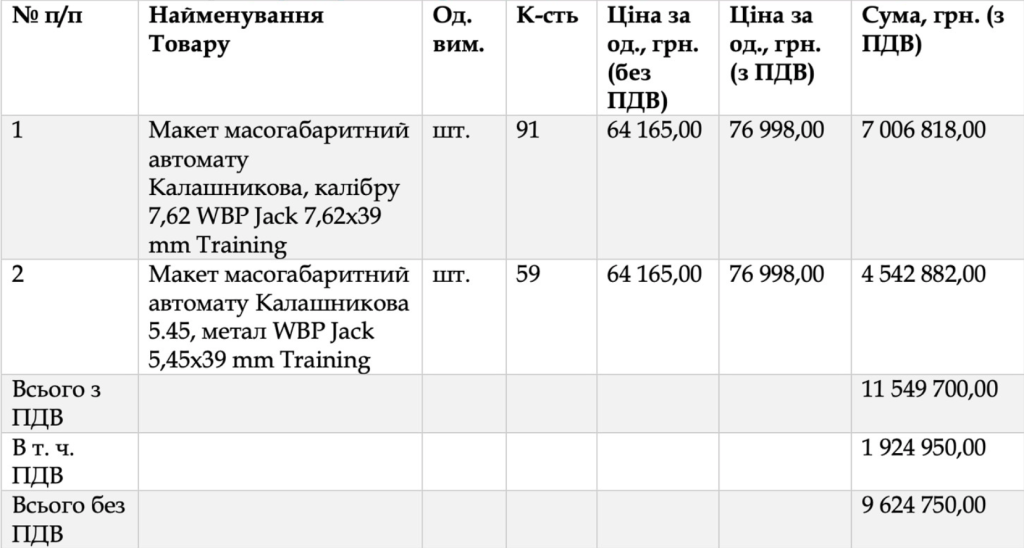
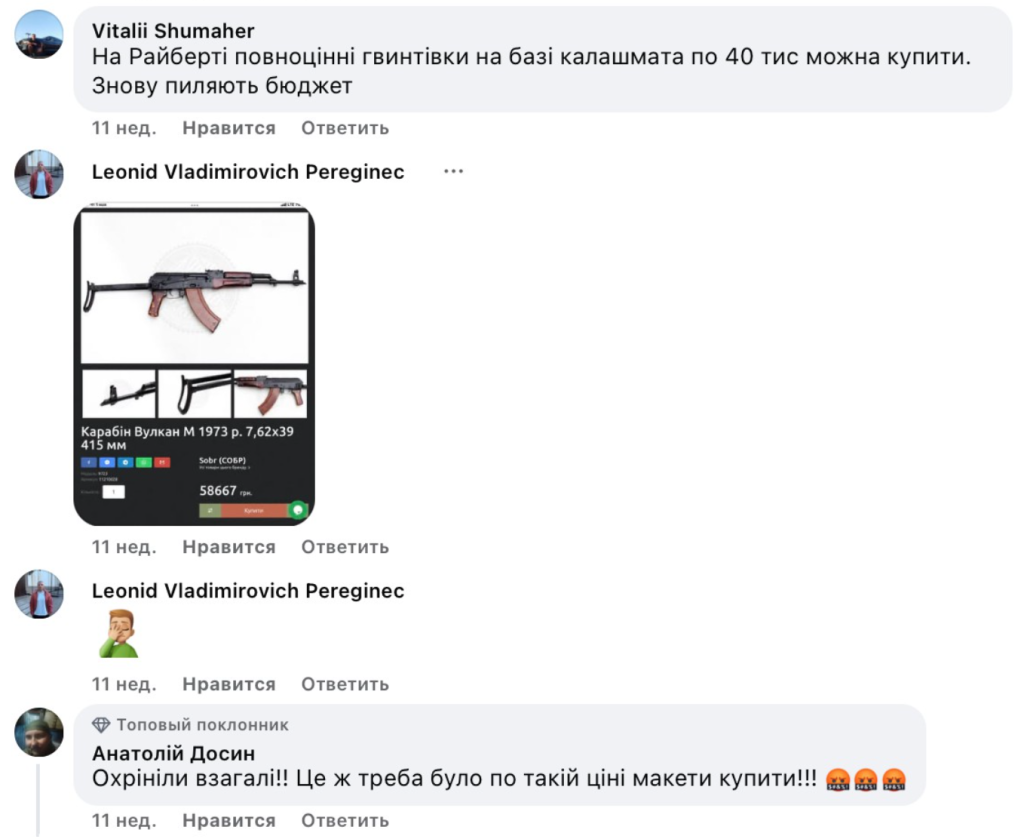
However, the market price of such training models is ₴62,500 — for example, GrafikaProm LLC sold the very same models in July 2025 to the Education Department of Krolevets City Council at that price. In December 2024, other educational institutions purchased these models for as little as ₴59,000 each. Thus, the difference between Optomix LLC’s tender price and the prices offered by other suppliers for 150 units amounts to between ₴250,000 and ₴750,000 — funds the state could have saved on this procurement.
This sparked justified outrage among citizens on social media. “Once again, they’re cutting up the budget”, Facebook users wrote.
How Rivne Fixer Andrii Rymar Created Fake Competition for Optomix LLC to Snatch ₴11.5 Million for Kalashnikov Mock-Ups
What stands out in this procurement is that Optomix LLC did technically have a competitor, sole proprietor (FOP) Serhiy Rymar. He offered to sell the rifle mock-ups for ₴11,745,200 — ₴195,000 more expensive. That automatically secured Optomix’s win. But let’s take a closer look at who Serhiy Rymar really is, the man who entered the tender with the least competitive price and never lowered it.
According to registry data, Rymar is a 76-year-old retiree from Kovel, Volyn region. He owns 11 land plots totaling more than 10 hectares and registered his FOP only on September 10, 2024.
It is more than likely that Rymar’s FOP was nothing more than a fake competitor in the tender, a setup to hand the contract to Optomix. When we tried calling Rymar’s personal phone, an unknown woman named Maryna picked up. She had no knowledge of the procurement and, when asked about rifle mock-ups, replied that no deliveries would be happening any time soon.
Moreover, according to BlackBox OSINT, behind the pensioner stands his 47-year-old son from Rivne, Andriy Rymar. Until May 14, 2024, Andriy was the founder, beneficiary, and director of TD RA LLC, a company with statutory capital of only ₴930. Today, that company has been re-registered under his wife, Tetiana Hnatiuk.
Between 2016 and 2025, TD RA LLC, registered at an ordinary private house in Kovel, 8 Berezovskoho Street, won state contracts worth about ₴178 million. Analysis shows that its main client has been Energoatom, particularly the Rivne NPP branch, along with the Khmelnytskyi and South Ukrainian NPPs.
Media reports indicate TD RA LLC has regularly supplied goods to the state at inflated prices. In 2021, it sold overpriced protective suits to a children’s hospital. In May 2023, Lvivteploenergo and Energoatom purchased big bags from the company, in some cases at double the market price. In August 2023, the firm sold office chairs to the Khmelnytskyi NPP for ₴14,382 each, for a total of ₴3.06 million, even though the same chairs cost under ₴10,000 on the manufacturer’s website.
Tetiana Hnatiuk also profits from public tenders. Since opening her FOP in 2016, she has won contracts worth nearly ₴24.4 million, mostly for supplying medical materials and equipment to hospitals. Meanwhile, the FOP registered under her father-in-law, Serhiy Rymar, in late 2024 managed in just nine months to take part in 938 tenders and win 48 contracts worth almost ₴6.9 million. This is especially suspicious, as a 76-year-old retiree who had just entered business suddenly began winning tenders for everything imaginable — from furniture and kitchenware to medical equipment and cleaning products.
This looks very much like a family operation, using a network of FOPs and LLCs to funnel budget money by staging fake competition in tenders and reselling goods to state institutions at inflated prices. Most likely, Rymar’s FOP was simply used as a token rival to ensure Optomix’s formal victory in the Ivano-Frankivsk Department of Education and Science tender.
And considering that the Department bought an interactive laser shooting range from Optomix at a price ₴517,000 higher than another supplier’s offer, we clearly see signs of budget losses averaging half a million hryvnias per procurement under the “Defense of Ukraine” program in schools and vocational colleges.
And, by the looks of it, Optomix was never a random company in this story. Beyond the Department of Education and Science, the Ivano-Frankivsk City Council’s executive committee also quickly began contracting the firm. Just two months after its registration, officials started awarding Optomix one order after another for frontline supplies. Naturally, most of these were non-competitive, with Optomix as the only bidder, pointing to a pre-arranged agreement between the supplier and city officials.
In 2024–2025 alone, the executive committee handed Optomix 14 contracts for radar reflectors, optical devices, laptops, mobile drone-detection systems, tablets, power banks, batteries, and quadcopters — worth a total of ₴3.02 million. Altogether, counting the Department of Education’s tenders, Optomix has already received ₴27.5 million from Ivano-Frankivsk officials in just one year of existence.
So it seems the Ivano-Frankivsk authorities, under the pretext of helping the military, simply found themselves a “friendly” supplier to channel money through. Or perhaps, conversely, a local businessman offered officials the “right terms” to ensure the funds flowed through him.
How Dmytro Shlimovych’s Sole Proprietorship Inflates Prices for Army Supplies in Non-Competitive Tenders
But the businessman in question is none other than Dmytro Shlimovych, founder and director of Optomix LLC. And, judging by the evidence, he is hardly a newcomer to siphoning budget funds in Ivano-Frankivsk. Beyond Optomix, Shlimovych has also operated as a sole proprietor (FOP) since June 3, 2010. For years, this FOP occasionally won tenders to supply office equipment to officials. But with the start of the full-scale war, it abruptly “pivoted” to military supplies, and business took off.
Today, Prozorro shows dozens of purchases where the Ivano-Frankivsk City Council executive committee, without any competition, buys all sorts of items for the army from Shlimovych’s FOP: DJI Mavic drones, kukri machetes, charging stations, polypropylene bags, even wristwatches. Whatever is ordered, Shlimovych delivers.
The executive committee “discovered” Shlimovych’s FOP in October 2023 and has been awarding him contract after contract ever since. To call them tenders would be misleading, since every single one had only one bidder. In practice, this meant prices were fixed — whatever Shlimovych quoted, the city paid. And unsurprisingly, he didn’t sell charging stations, tablets, and drones cheaply. On the contrary, the prices were inflated.
For example, in October 2023, the executive committee bought two Motorola DM4600E vehicle radios from Shlimovych’s FOP via a non-competitive tender for ₴79,998 — about ₴40,000 apiece. The market price? Around ₴30,000 each.
Or take DJI Mavic drones. In November 2023, the city bought a DJI Mavic 3E from Shlimovych for ₴137,000. Had the tender been competitive, the price would likely have been much lower — the market average is closer to ₴100,000. The same with the DJI Mavic 3T: sold on the market for about ₴168,000, but somehow Shlimovych managed to “push it through” to the city at ₴230,000.
We won’t go through every single procurement. But the pattern is clear: in most cases, the goods are overpriced, sometimes moderately, sometimes significantly. And that is hardly surprising. With no competition, and with tenders looking like a mere formality to rubber-stamp deals made in advance between officials and the supplier, the outcome was predetermined.
How Long Dmytro Shlimovych Has Been “Working” with Ivano-Frankivsk Officials to Drain Budget Funds
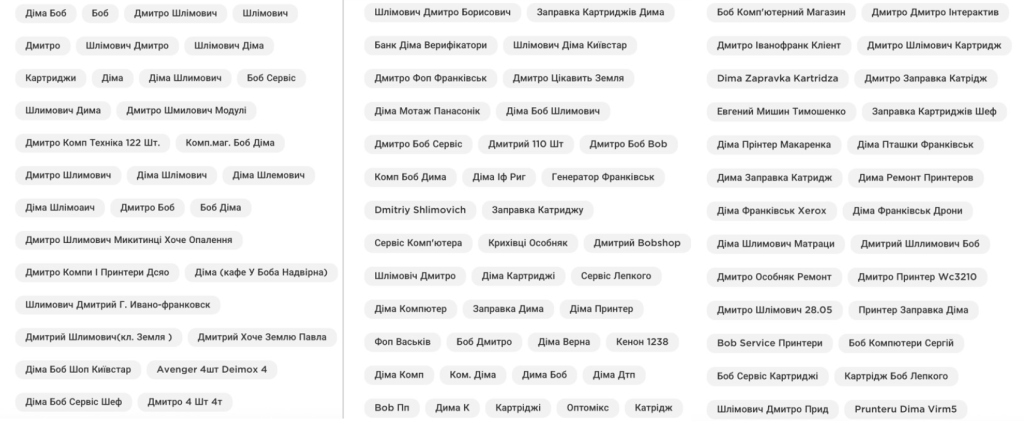
According to the tags linked to Dmytro Shlimovych’s personal mobile number in the GetContact app, it seems he is involved in just about everything — from refilling cartridges, repairing printers, and selling mattresses to buying land plots and dealing drones. The only thing that matters is that it pays well.
According to open data, he has been supplying goods to government agencies and regularly participating in state tenders for at least the past 10 years. Between 2015 and 2025, his sole proprietorship secured contracts worth ₴14.7 million. Before the war, his main product line consisted of computers, software, printers, and cartridge refills. But starting in 2023, Shlimovych shifted focus to supplying DJI Mavic drones, radios, and other goods for military needs.
In 2011, while already running his sole proprietorship, he founded a private company called “BOB”, which dealt in wholesale trade of computers, peripherals, and software. In 2024, the company was renamed Taurus Factum Line, where Shlimovych is now officially listed as the accountant. Between 2018 and 2024, this firm won government tenders worth ₴50 million. Just like Shlimovych’s sole proprietorship, before the war the company mainly supplied printers and cartridges, but today it delivers drones and spare parts for them.
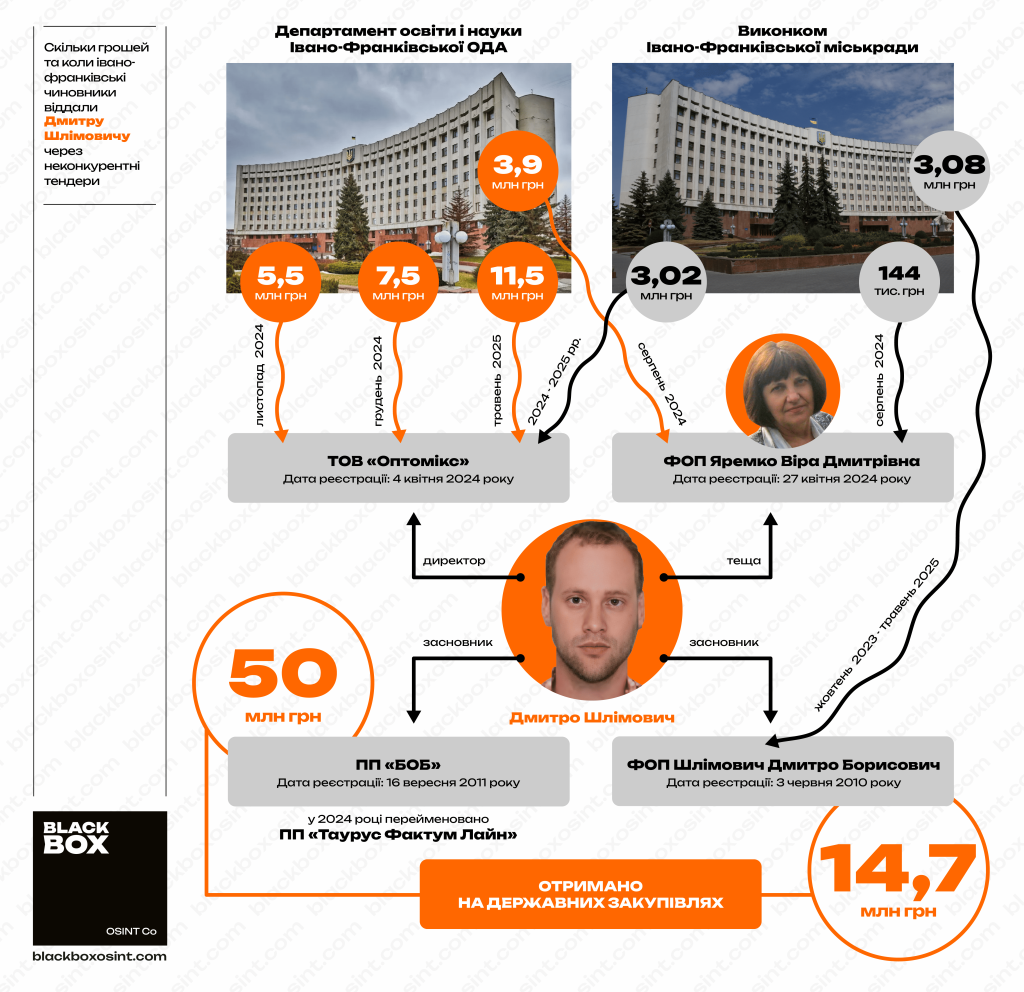
Thus, his close cooperation with the Ivano-Frankivsk City Council’s executive committee and the Department of Education and Science of the Ivano-Frankivsk Regional State Administration in tapping budget funds for the army is no coincidence — he has been working with them for many years. That is why, for Shlimovych, it’s no problem to register a new LLC and, just two months into its existence, start receiving one contract after another from these state institutions, which seem unfazed by the company’s lack of experience, its tiny charter capital, and other red flags.
How Dmytro Shlimovych’s Mother-in-Law, Vira Yaremko, Joined the Family Business of Selling Overpriced Drones to the Army
It is likely that the creation of Optomix LLC in 2024 and the renaming of BOB Private Enterprise to Taurus Factum Line had one main purpose — to divert unwanted attention from the name Shlimovych, which constantly appears in procurement contracts with Ivano-Frankivsk state institutions. This way, it looks as if the city council and the regional education department are spreading their budget spending across multiple suppliers, rather than channeling it all to the same person.
Probably for the same reason, in 2024, on April 27, to be exact, Shlimovych’s 67-year-old mother-in-law, Vira Yaremko, also registered as a private entrepreneur with the same primary activity: non-specialized wholesale trade. Just like Optomix, only four months after registration, Yaremko’s business began receiving orders from the very same Ivano-Frankivsk City Council executive committee and the Department of Education and Science of the regional administration.
In August 2024, Shlimovych’s mother-in-law signed contracts to supply the city council with three EcoFlow DELTA 2 charging stations for military use at a total of ₴144,000, and to supply the Department of Education with equipment for media libraries — five sets of computers, furniture, and accessories worth ₴3,971,597. Both contracts, as usual, went through without competition — Vira Yaremko’s company was the sole participant and therefore the automatic winner.
Were the prices inflated in these deals? That’s easy to check. In June 2024, the same Department of Education bought the same media library equipment from another private entrepreneur for ₴8,243,653 for 11 sets or ₴749,423 per set. Yaremko’s price came out to ₴794,319 per set, which is ₴44,896 higher. That means the Department effectively overpaid Yaremko ₴224,500. Not a bad profit for a pensioner. Or rather, not for the pensioner herself, but for her overly enterprising son, Dmytro Shlimovych.
What Wealth Dmytro Shlimovych’s Family Has Already Gained from Supplying the Armed Forces
Thanks to the fact that Dmytro Shlimovych’s wife, 31-year-old Lidiya Shlimovych, worked as a civil servant at the Bankruptcy Department of the Western Interregional Office of the Ministry of Justice from 2016 to 2025, we were able to analyze her declarations and the family’s income. In 2022, Dmytro Shlimovych earned just $13,806 for the year. But in 2023, when he began supplying goods for the military through his private business, his annual income jumped to $70,200. And in 2024, after the creation of Optomix LLC, Shlimovych’s income doubled again, reaching $140,000 for the year.
Life for the family clearly improved. In June 2025, Dmytro’s wife Lidiya became the owner of a 2023 Tesla Model Y worth at least $31,000. Meanwhile, her mother, 76-year-old pensioner Vira Yaremko, bought herself a 2018 Audi Q5 in 2024, valued at around $25,000 today. Not a bad haul, all thanks to inflated prices on goods supposedly meant for the front.

Why State Watchdogs Don’t Frighten Ivano-Frankivsk Officials
Over the past few years, the Antimonopoly Committee of Ukraine has repeatedly caught the Ivano-Frankivsk Department of Education and Science colluding with contractors during tenders. For instance, in 2018, firms linked to each other won over ₴20 million in contracts to supply furniture for schools by imitating competition.
In 2022, the same department, during a tender involving companies that clearly acted in collusion, planned to spend more than ₴1 million on school shelter coolers at inflated prices, up to 70% higher than the market rate. According to media reports, in July 2024 the department was again caught trying to procure school computer equipment at prices twice the market value, from a company tied to a person under criminal investigation.
Dmytro Shlimovych himself has also attracted the attention of regulators. In 2019, the Antimonopoly Committee exposed a collusion involving Shlimovych’s sole proprietorship and that of Tetiana Vaskova. They coordinated their actions in a tender for multifunctional devices worth ₴205,040, announced by the Khmelnytskyi City Council. Shlimovych acted as a “technical” participant, deliberately submitting a non-compliant bid to secure the win for his partner. Both entrepreneurs shared the same address and phone number and submitted documents referencing equipment owned by Shlimovych. For these actions, the Antimonopoly Committee fined both ₴32,000 and banned them from public procurement for three years.
It is clear that the tenders organized by the Ivano-Frankivsk Department of Education and Science under the “Defense of Ukraine” program, aimed at preparing children for wartime, show the same signs of collusion with Shlimovych and his company Optomix. The head of the department, Viktor Kimakovych, has held this position since 2015. And judging by the facts, neither the Antimonopoly Committee nor law enforcement agencies pose any threat to him. The same applies to members of the Ivano-Frankivsk City Executive Committee, who freely exploit the Cabinet of Ministers’ resolution allowing simplified, non-competitive wartime procurement.
And this is just one of many cases showing how, in the middle of war, officials in the rear misuse funds for military aid and national defense programs by colluding with shady businessmen in sham tenders, pocketing profits from the state budget. It seems that national oversight of procurement has turned a blind eye to these local deals, even though they involve hundreds of millions of hryvnias. One need only recall the story of Dnipro Deputy Mayor Kseniia Sushko, mired in school repair tender scandals yet never held accountable.
P.S. Interestingly, 48-year-old Dmytro Shlimovych, officially registered in Ivano-Frankivsk in 2025, lists Haifa, Israel, as his residence on his Facebook page. If true, it makes the story even more outrageous: looting Ukraine’s defense budget for profit while living abroad is the height of audacity.