

Over the past two years, Ukraine has seen a wave of high-profile arrests: Supreme Court Chief Justice Vsevolod Kniaziev caught with a $2.7 million bribe; the head of Khmelnytskyi’s disability commission Tetiana Krupa found with piles of cash at home; MP Mykola Tyshchenko involved in a scandal over kidnapping a soldier; and a warrant issued for former Health Minister Maksym Stepanov, now hiding abroad. Yet none of these cases have reached a conclusion. None of the suspects have been punished. In fact, nearly all of them remain free.
Since Ukraine gained independence, many citizens have believed one thing: in this country, the corrupt go unpunished. Everything is negotiable. Any case can be closed. There are very few examples of top officials actually being convicted and held accountable. But there are countless cases that simply disappeared and were quietly forgotten.
We decided to check whether these headline-making scandals from the past few years have gone the same way. Have the key players who shocked the country with their greed and arrogance faced any consequences?
Where Tetiana Krupa Hid the Money She Made from Fake Disability Certificates
One of the loudest cases in recent memory is that of Tetiana Krupa — former head of the Khmelnytskyi Regional Medical and Social Expert Commission, local council member from Zelenskyy’s Servant of the People party, and officially awarded “Honored Doctor of Ukraine”.
Everyone remembers the infamous photo of her husband lying on a bed covered in stacks of dollar bills.

Tetiana Krupa was arrested on October 7, 2024, on suspicion of running a large-scale scheme selling fake disability certificates, which allowed men of conscription age to leave Ukraine during russia’s full-scale war. The court ordered her to remain in custody with bail set at ₴501 million, but later reduced it almost fourfold — to ₴112 million. Even so, Krupa couldn’t raise the money and remains in pre-trial detention, with her arrest extended until July 13, 2025. Her lawyers are now asking the court to slash the bail to just ₴7 million or release her under house arrest and lift the seizure on her assets.
And the seized assets could easily cover not just her bail but keep an entire city running for a year. Krupa made almost half a billion hryvnias from her wartime racket. Law enforcement confiscated huge amounts of cash, funds in foreign bank accounts, as well as luxury jewelry and accessories.
In her Khmelnytskyi apartment alone, investigators found $3,179,100 in cash and another ₴1.275 million. She also kept a Rolex SA-Geneve Suisse Oyster M watch worth ₴1.28 million and Dior Joaillerie earrings valued at ₴700,000. At her workplace, there was yet another stash — $93,000 and €2,000 in cash.
Her son Oleksandr Krupa also had his own pile, $296,200 and €8,800, along with documents on MSEC examinations for outsiders, likely “orders” yet to be delivered. And, of course, her husband had his cut too: $57,000, £3,995, and ₴3,728,500 in cash.
But that was far from all. Throughout 2022–2023, Krupa and her family periodically smuggled cash abroad — money paid by those seeking to dodge mobilization. Her husband Volodymyr traveled to the EU twice with large sums: on April 23, 2022, just two months into the war, he carried $207,000; a month later, on May 29, he took another $300,000 and €19,000.
In October 2022, Tetiana herself left with $600,000, which she deposited into a personal account at a bank in Poland. Her daughter-in-law, Kateryna Krupa, was also involved — on July 3, 2023, she took $200,000 abroad. In total, they tried to hide at least $1.35 million and €26,000 overseas — just in cash.
Investigators also discovered multiple foreign bank accounts in Krupa’s name and in the names of her relatives. In Poland, Volodymyr Krupa’s account held $1,245,293 and €11,372. In Austria’s Oberbank, Kateryna Krupa kept $195,000 plus a $540,000 deposit. She also had a Polish account with $200,600.
And, of course, no high-profile corruption case would be complete without a Swiss account. Working with Switzerland’s financial intelligence unit, investigators traced an account at LGT Bank AG (Switzerland) belonging to Tetiana Krupa, which contained another $599,000.
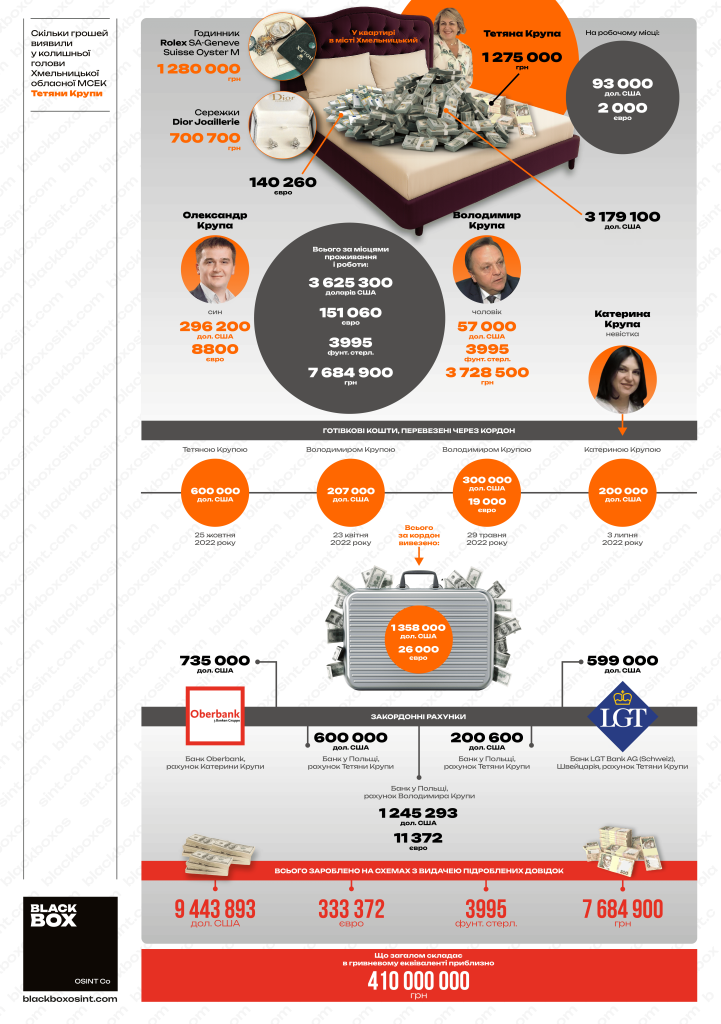
In total, if you add up all the seized cash, including funds moved abroad and money held in foreign bank accounts, Tetiana Krupa managed to “earn” an astonishing sum through her fake disability certificate scheme: over 410 million UAH in equivalent. One can only imagine how many forged disability documents she issued to soldiers and conscripts.
However, as it turned out, the Honored Doctor of Ukraine wasn’t getting rich from this alone. Between 2020 and 2023, the Krupa family, together with several individuals, including A.V. Bomko, A.S. Slastionov, I.V. Prokopchenko, and V.F. Lopez, ran a large-scale illicit enrichment scheme at the expense of the state enterprise Guaranteed Buyer.
The scheme involved using solar power plants installed not on residential buildings, as required by law, but on open land plots, which do not qualify for the “green tariff”. To legalize this activity and mislead the state, Krupa submitted forged technical documents stating that the solar plants were located within private households on residential structures. This allowed electricity produced in violation of “green tariff” rules to be sold to the state at an inflated rate intended only for households with rooftop solar panels.
As a result, according to investigators, the Krupa family and their associates illegally received 6,379,788 UAH in state funds.
Companies and individuals involved in producing fake technical documents included: LLC Khmelnytskyi Regional Land Agency, LLC Land Consulting Agency STS, sole proprietor Yudaieva, and sole proprietor Nimets.
For now, it appears NABU detectives and SAPO prosecutors are pressing hard on Tetiana Krupa. However, the case remains at the pre-trial investigation stage and has not yet been sent to court.
How Vsevolod Kniaziev Tried to Escape from Ukraine After Taking a $2.7 Million Bribe
The case of former Supreme Court Chief Justice Vsevolod Kniaziev is far less promising. On May 16, 2023, NABU detectives caught him red-handed, taking a staggering $2.7 million bribe. Kniaziev lost his position as head of the court, but still retains his status as a judge and remains free.
Just two days later, on May 18, 2023, the High Anti-Corruption Court (HACC) ordered his detention with the option of release on bail set at 107 million UAH. The HACC Appeals Chamber then steadily reduced this bail — first to 75 million, then to 55, 45, 35 million UAH, and finally, on December 21, 2023, to just 20 million.
On January 30, 2024, the HACC extended his pre-trial restrictions until March 29, 2024, and further lowered his bail to 18.168 million UAH. Kniaziev promptly left the detention center to await trial at home.
In spring 2024, his case went to court. At the first preparatory hearing, Kniaziev declared that he did not recognize his guilt, calling the charges “absolutely abstract”.
Then, on April 16, 2024, the court even removed his electronic monitoring bracelet, citing his claim that power and communications were out for six hours a day at his residence, and that the bracelet somehow harmed his health.
Unsurprisingly, on July 11, 2024, Kniaziev tried to flee the country toward the Romanian border. He failed, but faced zero consequences. His bail was not seized by the state, and he received no punishment for violating bail terms. No new arrest followed — he simply continues to live freely as if nothing happened.
Meanwhile, according to BlackBox OSINT, Kniaziev’s accomplice in the case, lawyer Oleh Horetskyi, made a deal with investigators, admitted guilt, and avoided prison. His “punishment” was limited to transferring 53.7 million UAH to Ukraine’s Armed Forces. In doing so, he disclosed full details of Kniaziev’s corruption scheme and named other Supreme Court Grand Chamber judges involved at every stage.
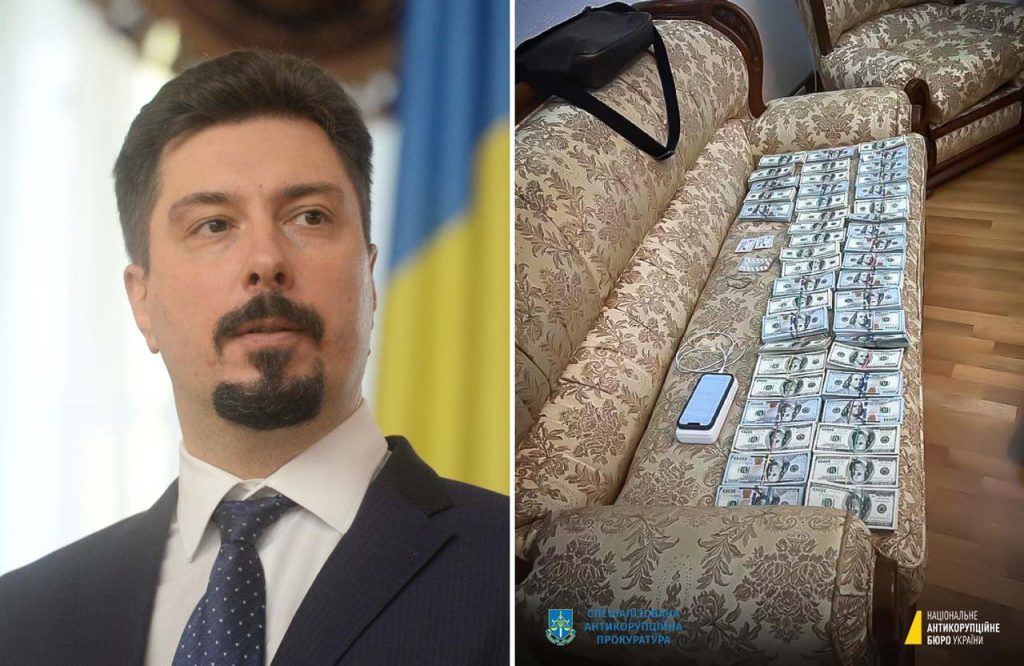
In particular, he provided investigators with detailed testimony about the involvement of several individuals in the crime — including the ultimate beneficiary of PJSC Poltava Mining and Ferrexpo AG, Kostyantyn Zhevago. According to Horetskyi, it was Zhevago who initiated the transfer of $2.7 million in exchange for a court ruling in favor of his companies. Based on Horetskyi’s testimony, the scheme involved the head of security at PJSC Poltava Mining, a lawyer from the “Illyashev & Partners” law firm (who coordinated directly with Zhevago), an intermediary, a close and trusted associate of Kniaziev, as well as the Head of the Supreme Court of Ukraine himself.
According to the lawyer, there was a prearranged chain for delivering the money, which included a safe at UkrSibbank rented in advance under the intermediary’s name. This intermediary received direct instructions from Kniaziev on how to distribute the funds among Supreme Court judges. Horetskyi also provided investigators with a list of judges from the Grand Chamber of the Supreme Court who were expected to issue a ruling in Zhevago’s favor. They were to receive part of the bribe, with Kniaziev personally approving the “reward” amount for each judge. This was not just an isolated act of corruption but a large-scale scheme of pressure and bribery involving multiple judges of Ukraine’s highest court.
In theory, this testimony should be key to proving not only Kniaziev’s guilt but also that of other high-ranking officials, including those close to Zhevago and members of the judiciary. However, despite investigators now having reasonable grounds to suspect not only the Head of the Supreme Court but also several other individuals, including other judges, no one has been arrested, no charges have been brought, and no new criminal cases have been opened.
Meanwhile, two years after his high-profile arrest for an exceptionally large bribe, which sparked public outrage, Kniaziev remains effectively free, unpunished for his attempted escape, and therefore able to try leaving the country again. It seems this may be exactly what is being facilitated. After all, removing an electronic ankle monitor from a top corruption suspect simply because it was “uncomfortable” can hardly be seen as anything other than helping him evade justice.
How the Court Helped MP Mykola Tyshchenko, Suspected of Illicit Enrichment and Kidnapping a Soldier
Another top official who remains unpunished is the scandal-plagued MP from the Servant of the People party and Kyiv restaurateur, Mykola Tyshchenko. He is accused of kidnapping and unlawfully detaining a former serviceman, who, according to the State Bureau of Investigation, was forcibly taken to an office building in Dnipro.
The case quickly gained publicity due to the high-profile figures involved and escalated into a criminal proceeding under Part 2 of Article 146 of the Criminal Code — unlawful imprisonment committed by a group of persons.
On June 25, 2024, the Pechersk District Court of Kyiv placed the MP under 24-hour house arrest with an electronic ankle monitor. However, almost a year later, on May 12, 2025, the Shevchenkivskyi District Court of Dnipro replaced the measure with a far more lenient nighttime house arrest — from 9 p.m. to 6 a.m. As in Kniaziev’s case, it appears the more influential the person in the dock, the more “comfortable” the preventive measure becomes.
Despite numerous motions from Tyshchenko and his ex-wife to lift the seizure of property confiscated during searches, the court has so far refused. The seized assets, €202,088 and $269,200 found in the apartment of his former wife, Alla Boranovska, along with $491,550, €390,100, and an Audemars Piguet wristwatch taken from Tyshchenko himself, remain frozen.
Notably, these same seized funds are also material evidence in another criminal case opened against Tyshchenko in April 2024, in which he is suspected of illicit enrichment, accepting unlawful benefits, and filing false asset declarations. That case has been stuck at the pre-trial investigation stage for over a year and has yet to be sent to court.
As for the kidnapping case, it has already reached trial: the indictment has been accepted, and the most recent hearing took place on June 26, 2025.
How Former State Printing Plant CEO Maksym Stepanov Stole Public Money
Former head of the state-owned Polygraph Combine “Ukraine”, the enterprise that prints Ukrainian passports, Maksym Stepanov, managed to pull off one of the boldest state heists in recent memory, quietly lie low for several years, and then reemerge as Ukraine’s Minister of Health in 2020–2021.
Only in July 2023 did the National Anti-Corruption Bureau of Ukraine (NABU) finally serve Stepanov with a notice of suspicion. Investigators accuse him of orchestrating, between 2013 and 2016, a scheme in which the Polygraph Combine purchased raw materials for biometric passports not directly from the manufacturer, but through an Estonia-based shell company, OU Feature, under his control. As a result, the state budget suffered losses exceeding ₴450 million.
For unknown reasons, the High Anti-Corruption Court waited until September 2023 — two months after the suspicion was announced — to issue an arrest warrant. By that time, Stepanov, well aware of the case against him, had already fled Ukraine, just like another figure from our investigations — European Solidarity MP Andrii Ryba.
Details of the fraud paint an even more cynical picture. Starting August 15, 2013, Stepanov effectively controlled OU Feature and, together with associates — including his accomplice Iryna Svyrydovska — arranged for the resale of passport production materials to the Polygraph Combine at prices inflated four to six times above market value. This markup alone cost the state €20,437,424 — equivalent to ₴450,012,522 — the exact difference between the actual value of the goods and what the enterprise paid.
But the profiteering did not end there. Realizing he could also cash in on intellectual property, Stepanov set up a second scheme. The protective element designs for Ukrainian biometric passports were created by the French company Surys. Normally, the Polygraph Combine would have paid Surys royalties for using these designs. Instead, Stepanov convinced Surys to transfer the copyright to his Estonia-based OU Feature in exchange for ordering their protective laminate. This way, he pocketed €7.3 million in royalties — some of which, investigators say, he funneled to his daughter’s account, including a documented $124,790 transfer.

In October 2023, the National Anti-Corruption Bureau of Ukraine (NABU) issued a second notice of suspicion to former state enterprise director Maksym Stepanov. Investigators allege that in February 2016, Stepanov laundered part of his illicit profits by signing a deal with the U.S.-registered “BPB Holdings” to sell a 25% stake in the Ukrainian company “UkrMineral”, with a nominal value of 500,000 UAH, for an inflated $750,000.
On May 23, 2025, another suspect emerged in the same case: Iryna Svyrydovska, Stepanov’s trusted associate. According to investigators, she acted as a nominal owner for part of his assets, handled all financial transactions to disguise their origin, and participated in sham contracts that legitimized the illicit funds, including fake “royalty” payments for the design of passport security features.
Svyrydovska is officially listed as the owner of “Pareton Consulting Limited”, a Marshall Islands company that, between March 2014 and October 2016, received €14,476,845.16 from the Estonian firm “OU Feature” under an agency agreement. In plain terms, this was just money siphoned offshore. BlackBox OSINT has confirmed that during the scheme, she traveled to Estonia annually alongside other key suspects.
Despite this, the court imposed only minimal restrictions: a bail of 5 million UAH (about €120,000) and a personal obligation. Compared to the €27 million allegedly stolen by her and Stepanov, this sum is laughable.
As for Stepanov, two years after the launch of multiple criminal cases, he remains untouched. He was placed on an international wanted list on August 21, 2023, yet authorities have failed to locate or arrest him. It appears that a man who defrauded the state of hundreds of millions of hryvnias is living comfortably abroad, enjoying his stolen wealth, while the investigation remains silent.
None of these cases have been closed, yet none have led to the obvious outcome: convictions and prison sentences for all involved. In fact, some court decisions seem to make life easier for the suspects, softening pre-trial restrictions. Hopefully, shedding light on these schemes will speed up the long-overdue justice against top-level corrupt officials who shamelessly looted their country for staggering sums.